Reefbuilders LED Showdown; Reef Central LED Police

Revised 12-5-15

I do not know whether to laugh or cry when I read blogs such as this one:

http://reefbuilders.com/2013/01/18/led-showdown-round/
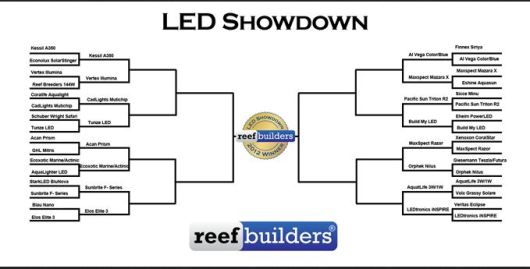
Skewed LED Aquarium Reef Light Showdown

While this blog “showdown of LED lights” is intended only for those that came out in 2012, it has the implication that these are the best, which simply is not true when looked at scientifically and as per warranties.

Just because an LED such as the EcoTech Radion is released in 2011 does not mean it is inferior to those in 2012

As well many LED Fixtures that officially are older yet by a year or two are updated constantly with new emitters or other upgrades
An example here would be the TMC 1000 Ultra which is a few years old, but has the newest patented Cree XR-E emitters AS OF 2012.

Using the implied logic in this Reefbuilders blog, a Ford F150 that has been around for years, but has a new engine is somehow inferior to a new model truck from company XYZ.
Gee, I thought a 2013 Ford F-150 was different from a 1970 F-150 model, but if I used the implied logic from the “LED Showdown”, I guess I am wrong??!!

Also missing were the 2012 AquaRay Mini 400 & 500s.
While these are not the top of the line LED, rather more than a niche LED, these are still vastly superior to the Finnex with its Chinese made Epistar emitter. Sadly the Finnex made this list while the AquaRay did not.
See: LED Light Information; Finnex
As well the excellent TMC AquaRay Fiji Blue 600 also released in 2012 was also snubbed, hmmmm.

Interesting too as per the TMC AquaRay snub, AquaRay has released the new & incredible Ocean Blue ND Ultima; Review and 600 Ultima; Review in December of 2012, so this competition is skewed here as well. One might argue that these lights will not be available to most until January or February for most of the buying public, but this is splitting hairs.


Revision, August 2013;
Reef Builders is showing their ‘true colors’ with this inaccurate review of the AquaBeam NP 1500 Ultima. In this review they get some very basic facts wrong.
See:
AquaBeam Ultima 1500 NP; Review Correction Reef Builders


Revision December 2013

I suggest looking at these two posts from this website, the first factually looks at warranties and the second looks at the facts of PWM versus Current Reduction Drivers, with the vast majority of over rated LEDs utilizing “current reduction”, including most featured in this ridiculous Reef Builders Poll.

*Aquarium LED Warranties; Reef or Planted
*Aquarium LED Lights, Controllers; What is Best


Revision December 2014

I actually have to praise Reef Central for one thread that while some comments were the usual Reef Central anecdotal BS, in the thread below many of the comments were more scientifically spot on:
http://reefcentral.com/forums/showthread.php?t=2391677

One in particular caught my attention in that he [Bryopsis] called out the lack of knowledge of PUR and the so-called lack of popularity of the TMC line of LEDs in the USA, when in much more seasoned European aquarium keeping circles they are well known. The facts are, as also pointed out, that TMC does no spend $$ marketing like EcoTech and others do in the USA, more on simply developing a better product with a warranty 2-3 times longer than all others.

Here is a quote:
“They’re a household name in Europe. As far as I know, there’s only 1 distributor here in the states.

PUR is a completely appropriate topic though when it comes to lights. It’s still another measurement that means something. It’s not just a fancy word like AI, Radion, Kessil, Maxspect would like you to believe.
You might think PUR is unnecessary or the brand isn’t well known, I see the opposite of this.

Why does nobody use the balling lite system, or even the Triton method? I don’t see a lot on the Triton method, that doesn’t mean it’s irrelevant. That’s why I enjoy my time on the European forums more than the US forums. Any way you slice it, the Europeans and other countries have been keeping fish much longer than the United States folks. I surely won’t dismiss anyones methods etc, but I think the bottom line is they have more experience in the fishkeeping hobby. (by several hundreds years at least)

Over in the European forums you see these crazy tanks running for years with no water changes yet doing just fine supplementing additives.
In the USA, people say additives are the devil and I see the majority of people asking how to keep some of the basic chemistry in check.

I won’t make any assumptions on who’s right, but I see a lot of bickering on the US forums as compared to legitimate progress between multiple people in the Euro forums. It’s definitely something to think about.”


I should point out that there are some good LEDs in their “showdown”, but limiting this “competition” to just 2012 LED releases based on hobbyist preferences and snubbing one of the top notch LED brands used by many professionals makes for a VERY skewed competition.

In another ReefBuilders thread, a person commenting hit the nail on the head about how this website along with Reef Central are NOT places for those desiring scientific reasoning should visit.

Here is his comment (from; http://reefbuilders.com/2012/01/10/2011-led-showdow/):
You mean the purchased badge? Just like Ecotec purchased out reef central? Anyone dare say anything against ecotec and they get the ban hammer faster then the black plague.. Its too bad everyone else in this showdown didn’t get a chance to mass span everyone begging for a vote.

This person has exactly summed up my experience along with others.
Even EcoTech’s own emails ask those inquiring questions to go to this forum.
WHY; because they have bought and paid for this forum.

How otherwise intelligent persons can recommend a LED fixture that utilizes “cool white” emitters and uses “current reduction” instead of the vastly superior “pulse width modulation” to control their LEDs screams out that this forum is bought and paid for!!!!

If you disagree, you WILL get attacked at the very least with straw man arguments that attack the person, NOT the facts.

NOTE:
What is interesting is the comment I quoted from Reef Builders about the Reef Central “Ban Hammer” was scrubbed clean as well as all other comments!
You think they made too good a point and hit a raw nerve with the Reef Central LED Police????

Further Revision;
The Reef Central Link Police have struck again (as a ping back to this webpage found):

Reef Central LED Aquarium Light Police
From this thread:
http://www.reefcentral.com/forums/showthread.php?t=2386209

With again personal attacks at Reef Central on author credibility rather and address the facts, including comments such as this:
“No way TMC makes the best LED on the market. GHL and Ecotech”
AND “IF that were the case don’t you think there would be countless threads and posts referencing this relatively small player in the LED game “
REALLY?!

Gee, what about PUR? The SIMPLE FACTS of lost energy as heat instead of light? The use of PROVEN useless green emitters? Lack of PWM by EcoTech?????
TMC simply has not bought their way into forums such as Reef Central here in the USA. Even some simple investigation will show that EcoTech is a late comer to the high end LED market, not TMC (which is very popular in Europe, certainly not a small player).
As well science is NOT a popularity contest, sure if you want to be lemmings and follow these buffoons at Reef Central over the cliff go right ahead.

Reef Central continues to show itself as a dishonest, heavy handed forum, where SIMPLE scientific facts are thrown out the window in lieu of personal Ad hominem attacks.
They cannot even get simple facts straight of which LEDs were available on the market first.

In fact I remember when the EcoTech did come out, and I was discussing this light with others at an LA marine livesotck dealer, the others thought the EcoTech would not get very far because it lacked essential lighting elements and was much more gimmicky than the already well established premier TMC Aquaray lights. Admittedly we were wrong here, as we did not anticipate how well Reef Central would be able to pour the Kool Aid down the throats of so many gullible persons who read their awful forum, then cut and paste into other gullible forums such as PNWMAS!

Highly Suggested Further Reading:

Why Aquaray LED Light Fixtures, Review? This is one of my posts outlining the facts that separate the Aquray lights I have come to support and all others.

http://aap.atrixnet.com/?p=338
The above link has an excellent graph that plots the PUR of actual emitter used by the EcoTech.
If this does not convince any reader why the EcoTech is far from the best LED, I have some beach front property to sell you in Barrow Alaska!

St. Marys Marine Biology LED Experiments
Professor Walter of St. Mary’s College of Maryland University LED Study.

Suggested Reading that I found for those looking for a more factual comparison:
Aquarium LED Comparison
Make sure to look over the chart near the end of the article!

The bottom line, while this “showdown” might be entertaining to read; realize this is simply a good read while enjoying some good cannabis and nothing more.

Must Read Aquarium Information Websites

This is certainly not a complete list of aquarium help/information, but these are ones I CAN vouch for their sources.
Admittedly two websites (Aquarium Article Digest and Aquarium Supplies & Resources) have cited/interviewed me among others as their source of information.
This does not take away their credibility, as I know one website in particular (Aquarium Article Digest) uses dozens of resources and even guest authors (whom I do not know).

The other websites I recommend are based on what I view as simple yet good information.

I should also note that I started this website only recently to counter all the misinformation I find via customers who make me aware there-of.
I am far from an expert in websites (as the amateur quality of the website design shows), and in fact I am rare online. Much of my time online is ONLY after I have a client tell me about the “lasted thing they read online”, for which I investigate.
For this reason I am not always aware of all the good websites either, only the “bad” ones I am made aware of by my clients.

Since this blog over all often has a negative tone based on the reasons I get online in the first place (to explore strange advice my clients repeat to me that they found online), I felt having a positive post about websites I can recommend was long overdue.


Aquarium Article Digest

This article is especially excellent for its articles on lighting, such as “LED Aquarium Lights, Lighting Information“.


Aquarium Supplies & Resources

This article has a great listing itself of many top notch articles in this article: “Unique Aquarium Articles


Sponge Filter; Information

While not a flashy website, I found the articles simple and “spot on”


Aquarium Medications

Great accurate article about the use of aquarium medications and treatments, as well as where to get them.
Again I found this website spot on with the article about Furan 2 interesting since this is a product I often find useful.


Fish Beginner

A client stumbled upon this neat little gem and told me about it.
I especially like this article from this website:
Aquarium UV Sterilizer Use; Choosing & Maintenance– This article includes simple but accurate information about choosing a replacement UV bulb

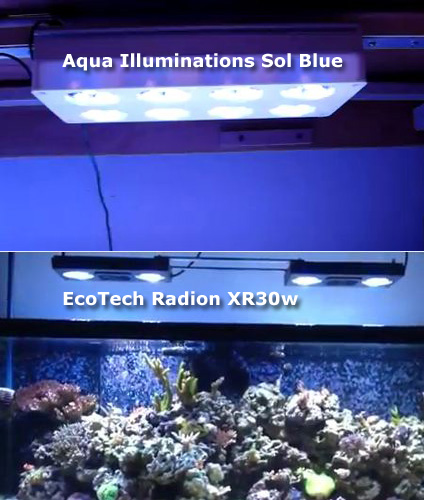
EcoTech and Aqua Illuminations LED Review

EcoTech and Aqua Illuminations LED Review, ComparisonRevised 5-6-14

I will start this review of these two popular LED Aquarium Lights in a different way from my other reviews.

The reason is while these are nice, feature rich LED fixtures that produce good results, these are NOT the best and the scientific evidence is easy to find if you simply dig deeper than an aquarium forum or Google search. This IS well known in the industry science based information to back this statement up.
Yet, I was made aware by a couple of clients of personal attacks in forums against the authors of blogs/websites that bring up these points/evidence rather than deal with known facts or simple professional experience. While admittedly my experience and that of my friends in the professional aquarium service business who use many different LED Fixtures is anecdotal, this still counts along with known FACTS about current LED Aquarium Lights.

So after a little digging on the Internet and even more digging around by asking friends in the industry, I found a revealing fact, and that is these two companies; EcoTech and Aqua Illuminations, often speak at and sponsor forum and club meetings.
As well you have persons such as Sanjay Joshi heavily promoting these LED fixtures using his credentials as proof, yet ignoring the science of PUR & PWM while going over board on PAR readings produced by emitters producing high amounts of USELESS PUR light energy, while copious amounts of input energy is lost as heat due to the technology used to drive the emitters. Unfortunately I know of professionals with vastly more experience than this man [in one case 1978 versus 1992)], yet this person gets so much credibility? One reason I also suspect is catchy, cool photos that prove nothing. If someone produces great photos proving man never landed on the moon, would you believe this too [unfortunately this has been done too].

What does this mean? well for one I think the moderators and members lose most of their objectivity due to sponsorships and gullibility of reading pseudo scientific information as noted earlier. So when they read about a review that promotes the “wrong” LED and shows the short comings of EcoTech, Aqua Illuminations, and other LEDs, these persons resort to personal attacks.

Admittedly I cannot prove my opinion as to the ‘why’ of these actions, but I ask anyone reading to otherwise explain why it is primarily forums/clubs that promote these two companies LEDs while trashing those who question them?

So what are the known facts besides the observations made by me and so many others in my profession that show both these LEDs to be good LED fixtures, but not the best?

* Drivers/Circuitry:
Both the EcoTech and AI Sol do not attempt to use dozens of low output one watt (or less) emitters daisy chained together which further lowers the actual PUR output of each emitter.
Rather both these fixtures go the route of quality CRee emitters tied together with excellent circuity. This is important as unlike other light types, the more emitters in a circuit the more complex the drivers must be to keep very exact voltage for optimum useful energy output.
This is a problem with the Sky LED.
See my post about these LEDs: TaoTronics, SkyLED, Skkye Marine, LED Light Reviews
.

However this is where the EcoTech MAY have a couple negatives; as I understand that when you have controls to vary RGB output, this results in less than optimal PUR light output.
I have to admit that I do not know for a fact that this is a problem, although this makes sense as an LED is not a bulb, rather a light emitting diode, and even small changes of voltage can therefore affect spectrum.
But what I do know is that I would rather have a factory set LED fixture where by the emitter output is EXACTLY what my reef inhabitants need without wasted green emitters to make a ‘pretty green color’ should I choose. I would also note that it would be easy for me or a client to inadvertently change the RGB setting to a less than desirable nanometer output.
For me, I have to agree with other blog reviews that this is not a desirable feature of the EcoTech Radion, but I would also state from my use that this is not a “game ender” either.

The other negative for the EcoTech Radion XR30, Radion Pro, & Aqua Illuminations is the need for a cooling fan that the AquaRay, and other high end LEDs that utilize the vastly superior PWM* technology do not require.
From my discussions with others who know more about electronics than me, this indicates more heat producing voltage spikes are being allowed in the emitter drivers.
These same voltage spikes also degrade essential PUR/Useful Light energy output and wastes energy that would otherwise go into lighting your aquarium.
In fact wasted energy as heat is probably my biggest complaint with either fixture and in fact is one of the more provable facts against these two LED fixtures, as it does not take much more than a 5th grade education to realize that ANY energy that is going to heat is NOT going to light your reef aquarium!

*PWM = “Pulse Width Modulation”
Reference: Aquarium LED lighting; PWM

* Emitters Used:

The AI Hydra Fifty Two uses (16)Cree XT-E Cool White, (4) OSRAM OSLON Deep Red, (4) XP-E Green, (12) Cree XT-E Royal Blue, (8) OSRAM OSLON Very Deep Blue, (4) SemiLED 415nm Violet, & (4) Edison Opto 400nm UV

While definitely an improvement on earlier AI LED models, the facts are that the standard binned Cree XT-E Cool White LED emitters used by AI are inferior when it comes to important PUR light production.
As well the use of UVA 400nm emitters is questionable, as at this time there is no science based evidence that this is a beneficial light wave length when it comes to PUR required by corals and in fact possibly burn corals.

~~~~~~~~~~~~~~~~~~~

The EcoTech Radion uses Cree XT-E Cool White LEDs run at 5W each, Cree XP-E Blue LEDs run at 3W each, Cree XT-E Royal Blue LEDs run at 3W each, Cree XP-E Green LEDs run at 3W each, Semi LED Indigo LEDs run at 2.5 watts, and Osram Oslon SSL Hyper Red LEDs

As noted in another LED Review Website, that was attacked by the Trolls of one of the forums I referred to, the mixture of blues is the biggest selling point of the EcoTech Radion. The emitters used compliment each other very well in this LED fixture.
Reference: Aquarium LED Reviews; EcoTech

Now the down side: While the EcoTech attempts to get around the use of Cool White emitters by boosting output, the fact remains that cool white is even worse than the use of 6500K emitters for a reef aquarium.
You couple this with the totally useless green emitters and you have a lopsided PUR heavily favoring some excellent blue PAR, but more useless green than is necessary, which also comes from the cool white emitters.
On one positive note, the red emitters do salvage the PUR spectrograph, so this results in at least a reasonably capable Reef LED with some wasted green light energy.

Another interesting point about the EcoTech Radion, is that its emitter color mix is similar the TMC AquaRay Color Max.
The Color Max uses Uses 4 Daylight Cree XP-G (9000K); and 2 green, 2 red, and 2 blue Cree XP-E Power LED emitters.
YET, I have seen the Color Max panned for being more of a decorative LED light when while this is partly correct, it has a color mix very similar to the EcoTech Radion including a better daylight emitter. I find this hypocrisy among Reef Keepers rather amusing

* Emitter Patents:

This is where I have noticed attacks getting personal in some forum posts I was forwarded.
My guess is since they either cannot grasp this FACT of business or do not want to deal with it, they attack the “messenger” of these facts.
It is not rocket science that most businesses have development costs and when these business have new patent on either an existing product update or an entirely new product, they are to sell these to the highest bidder or those companies that have contracts for newest patents.

Where am I going with this? Well it is quite well established in the industry that TMC has patent rights for the newest Osram Olson & Cree emitters. The result is the XT-E emitters used by EcoTech or AI Sol is NOT the same emitter used by TMC.
The result? This also is not rocket science and that is the XR, XT and XP emitters used by EcoTech and Aqua Illuminations are certainly good and capable emitters, they simply ARE NOT the best available as these are simply the over the counter emitters ANYONE can purchase.
No different than an earlier generation electronic devise may work quite well, but is not as capable as the newest generation. This difference usually results in a less efficient emitter, lower spectral quality, or both.

* Warranties:

Both the EcoTech and Aqua Illuminations are only warranted for a year, not a lot for an expensive electronic device, especially when others have up to 5 year warranties!
A new post from this website looks at LED warranties, See:
Aquarium LED Light Warranties

* References, Recommended Resources:

Aquarium LED Light Reviews

LED Aquarium Lights, Lighting

TMC Aquarium LED Light Review

Ecotech Radion XR30 LED Light Review

YouTube; Why the AquaRay that uses PWM Technology is the Best LED

And finally, yes I too have a Bias; I am biased toward products that work BEST and have known facts to back them up!

TaoTronics, SunSpect, SkyLED, Skkye Marine, LED Light Reviews

Revised 12-12-15

Please also read this article for a factual explanation of many of the points I make against these Aquarium LED Lights:
Aquarium LED Lights, Controllers, RGB, Emitters; What is Best?

OVERVIEW

These are three possibly four of the more questionable LEDs on the market if considered for a reef aquarium.
Sadly many actually purchase these due than often less than honest marketing by companies such as Amazon or eBay thinking they might get a “top notch” Reef Compatible LED, which the TaoTronics/SunSpect might be reef compatible, but MOST CERTAINLY NOT top notch.
Even your savings, since these are as little as $90 usd is of little good when the fixture goes belly up from moisture damage or is accidentally dropped in the aquarium since cheap Chinese made fixtures do not have an adequate water resistance/proof rating for an aquarium environment. Keep in mind that even the short warranty on these LEDs does not cover damage from water.

It is also worthy of note that the reef compatibility comes at a higher cost in electricity used due to less efficient emitters, drivers, & especially controllers used, as per PUR NOT PAR despite many claims of PAR µMol readings while overlooking the VASTLY more important “Useful Energy”/PUR.
As an example; basic science and math tells you that if you are using emitters that produce 20% more green and yellow spectrum light energy than another whose emitters produce 20% less, you are NOT going have the same PUR, which means a higher wattage, PAR rating, and higher carbon footprint will be required for the same results!

Marketing claims include “replaces a 400 watt Metal Halide”. REALLY? I do not think so, maybe a 175 Metal Halide at best, especially when one considers how much wasted energy goes out as heat compared to better technology LED lights that utilize PWM, and more light energy is lost in less than optimum efficiency emitters and drivers.

The Sky LED is not at all reef capable, only fish capable, although at least the Sky LED is not marketed for such either.

TaoTronics Aquarium Reef LED Light Fixture, ReviewThe TaoTronic [AKA the SunSpect], which is unfortunately marketed as a high end reef capable LED light.

While a few of the reviews might be good, lets look at the facts, if only from their own literature.

[1] Requires cooling fans;
Why? A well made LED fixture such as the ‘top notch’ AquaRay, or others should NOT require a cooling fan, only heat sinks.
Half the cost in building a top notch Reef LED (or planted freshwater LED) is the circuitry/driver/controller that maintains important voltage over all emitters, otherwise issues of nanometer spikes, excess heat, etc. can arise and the fact this LED fixture requires a cooling fan speaks volumes.
Again, VERY BASIC SCIENCE says that heat energy equals LOST ENERGY that will NOT go to light energy, so the fact these LED fixtures and so many others as well require a cooling fan again simply means a higher wattage LED fixture is required to do the job.

Why do these require a cooling fan?
Most LED fixtures, including the Taotronics utilize the very inefficient Current Reduction technology to run their LEDs rather than the more efficient PWM technology.
“Current Reduction” produces much more excess heat, and also changes the light spectrum.
This excess heat represents wasted energy that must be made in extra emitters to do the job of a much better designed LED fixture (such as the before mentioned AquaRay).

See also Aquarium LED Lights, Controllers, RGB, Emitters; The FACTS

In summary, the use of cooling fans is often a symptom of poor circuitry/drivers/controllers that produce excess heat.
Please read further as to why the drivers/circuitry DO play a major role in the quality of light produced by an LED!!

[2]The next problem with all Taotronics lights is these are not water proof, in other words not a water proof design of IP67.
So what this mean is your low cost LED, which is a light emitting electronic device is now being place in wet aquatic environment with a warranty of one year.
What happens if it stops working in 15 months?

Worse as in the case of a service customer that contacted me after they purchased one on Ebay, then they proceeded to accidentally drop one of the two fixtures they purchased in the water. The result, this light failed and the warranty would not cover the light even though just purchased two months earlier.

What it really comes down to when it comes to the Taotronics/Sunspect LEDs and anyone who thinks they are getting a bargain, I have this quote:
“A fool and their money are soon parted”!!!!

[3] Why are so many emitters required???

This is similar to the shotgun approach to using early T12 fluorescent lights 25 years ago; why when there are excellent new generation Cree, Osram Olson, and Orphek powered LEDs available!!
This is not to say the TaoTronics cannot work, rather why go with this energy wasteful older generation emitter technology when there are better LED Light Fixtures that use less energy, produce more PUR, and likely will last longer since the Taotronics only has 2/5 of the warranty (with better companies standing behind them too)??

[4] As well, and thoughtful reader should note that the exact Kelvin, emitter bins, etc., are not cited. Even a simple Spectrograph has not been submitted by TaoTronics!
This is for the reason that these daylight emitters are far from exacting. In fact I challenge any reader to go down to their local hardware store and purchase similar wattage “bright daylight” flashlight LEDs and produce the exact same results as these low end LED fixtures that essentially utilize cool white daylight emitters and less exacting older generation blue emitters.

I also challenge those who would argue that utilizing a cool white emitter is OK for good results; WOULD you use a ‘Cool White’ T5, CFL, or Metal Halide Light over your Reef Aquarium?
The answer in just a quick scan of the Internet of what others say is NO!! So why is it OK for an LED Fixture to use these emitters??

BTW, I am NOT saying adequate results might still be achieved with these LEDs and opportunistic specimen placement. One is simply achieving results in a shotgun type method with a lot of wasted energy!!

[5] Another aspect that many persons are not aware when it comes to exacting light energy produced by a well designed LED fixture is the drivers that keep voltage over each emitter to VERY exact voltages.
One cannot “daisy chain” LED light emitters together like you can Christmas lights.

Here is a quote from Sunspect LED listing on Ebay:
“All LEDs with a zener to ensure one LED goes out the rest continue to operate”
This can only happen if these are daisy chained together.
So again think twice if you are really getting a quality light with the Sunspect or Taotronics, as again all you are getting is cheap Chinese cr## that might work for a while, but not very long.
Ref: https://en.wikipedia.org/wiki/Daisy_chain_%28electrical_engineering%29

Each individual emitter can change the voltage to other emitters, if only by fractions, however with an LED emitter designed to produce exacting light energy, this can make a big difference light spectral quality.
LEDs are not typical lights such as a CFL, these are essentially electronic devices that emit light!!!
As well, the FACTS are Pulse width modulation (PWM) is required to maintain spectral quality and the TaoTronics DOES NOT utilize this expensive technology, rather the much less expensive current reduction reduction method as noted earlier!

The bottom line is; the more emitters, the more complex and expensive the drivers, so when you have a fixture such as this TaoTronics LED with a shotgun approach of emitters yet with essentially no adequate drivers, you are essentially stringing hardware store LED flashlights together over your aquarium.
There is no way one can have an LED fixture for the price of the TaoTronics with complex drivers any more than a $300 Laptop is going to have Intel’s best computer processor. Of course the answer is simple with these cheap Chinese Drivers.

Please Reference:
Aquarium LED Light Information; Overview

Another TaoTronics LED, the “TaoTronics LED Aquarium Coral Reef Tank Blue White 2:1 LED” uses too many blue emitters for the average depth aquarium these are used for, thus lacking adequate Photosynthetic response.

This quote from Aquarium LED Lights, Lighting sums it up well:
“Think of it this way, if you have an automobile that is designed to run on 91 octane fuel and you use 89 octane, likely your vehicle will still run, but not to its potential and with possible long term damage too; this is what happens when not all aspects of Photosynthetic response are met due to over use of blue lighting in a relatively shallow aquarium.”
Also check our the many references cited by the above quoted article for those who want to continue to believe non scientific observations.

See Also: Blue Moon Aquatics LED
The above reference has the Spectrogram published by Blue Moon showing vastly more blue than is best for an average reef tank.
This LED is made in the EXACT same factory in China (which builds these LEDs for distribution under any company willing to purchase and place their name on the product).

Between the older generation emitters (especially with the “TaoTronics Aquarium Coral Reef Tank White/Blue LED Lamp 120 Watt”), low quality drivers & controllers, shotgun approach to lighting, poor PUR is going to be the result!

Further Comments

The other perplexing question is why anyone would spend close to $200 for this LED when for $300 or less, one could have a 100% new generation reef capable LED that uses much less electricity in the AquaRay 2000 or 1500 Ultima, or even the lesser but still capable AI Sol, or EcoTech LEDs??
Recommended References:
Aquarium LED Lights, Lighting; What to Know for Reef/Planted
Aqua Illumination Sol LED Review
EcoTech Radion & Radion PRO LED Review
Recommended Resource for Planted Aquarium LED Review:
Customer GroBeam 1000/1500 Review

What is so absurd is the persons who might brag how they have kept reef life with their Taotronics Aquarium LED and have spent less money up front.
But are these persons saving money?
NO, not when it takes 2.25 to 3 watts per gallon for a Taotronics to achieve the same results as an AquaRay 2000 NP Ultima at only .8 watt per gallon. THIS IS TRIPLE THE WATTAGE!
This defeats the purpose of purchasing an LED Aquarium Light in the first place, to save on electricity and lower heat produced by Metal Halide lights.

As an example of this absurdity; you are going to replace your (2) 150 watt Metal Halide fixtures on a 75 gallon reef aquarium, only to purchase (2) 120 watt Taotronics.
You have only saved a total of 60 watts to questionably do the same job??
While you could have purchase (2) AquaRay Ocean Blue 1500s at 30 watts each (60 watts total) to do this same job of lighting a 75 gallon reef aquarium.

Not to mention the reliability of these Taotronic LEDs and their cooling fans that have been reported to actually catch on fire, and one has to wonder about the logic that goes into purchasing the Taotronics LED just to save a few dollars up front?????
The Warranty is only two years, limited too (repairs), compared to 5 year for the industry leading AquaRay at 5 years (full replacement).
See my post about warranties: Aquarium LED Warranties

I HIGHLY suggest reading this very informative article by anyone even remotely considering the TaoTronics LED:
Aquarium LED Lights, Lighting; How they work

For more about my response as to the TaoTronic LED from those such as a person who attacked me from 3reef.com/forums with disingenuous “straw man” arguments, please read this editorial on my Home Page:
Commentary on Attacks from 3Reef.com

Finally on a related note, as person who has a lot of time and experience invested in the aquarium hobby, I hear and see much of what my clients have purchased or have been told.
One common thread is the junk often sold via Amazon or the terribly inaccurate Amazon social media driven reviews which often have absolutely no bases in fact, often due to incomplete sales of many products for proper function (to keep the price low) such as the Rena Smart Filter.
The Taotronics LEDs are a further example of why Amazon is not the place to purchase or get accurate aquarium supply information.

See my newer article about Amazon based on an email forwarded to me by a friend in the industry:
Purchasing Aquarium & Pond Equipment via Amazon

SkyLED Aquarium LED Light Fixture, Review, from Pet Mountain, TruaquaThe SkyLED along with the Marine Skkye is another vastly inferior LED, however at least it is not generally marketed as anything more than a large decorative LED Fish only aquarium light.

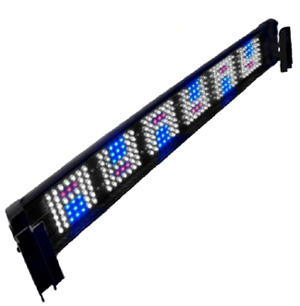
The popular SkyLED 36 inch model has (378) bright white, blue, and red LEDs; none of which are from exacting LED emitter bins.
At 23 watts and 378 emitters, this comes to only .06 watt per low PUR output emitter, making this a decorative light only.

This said, as a pricey replacement for two 30 watt fluorescent lights over a fish only tank, this LED will certainly use less electricity than two or even one fluorescent light PLUS add a nice sheen and color your fluorescent lights cannot achieve.

I will also note that I have used this light for demonstration, and can vouch for the nice decorative only features.

So in summary for the Sky LED, it may be a worthwhile purchase under the correct criteria with probably my biggest complaint not with the light itself (again under correct use), but with those selling this light.
The two main sellers are TruAqua and Pet Mountain, both of which have notorious reputations within the Aquarium Industry for poor integrity that frankly I feel for friends I know in the industry who have been hurt by their poor ethics, of which I am uncomfortable divulging at this time (maybe someday with their permission)


The Marine Skkye is another Chinese knock off using inferior low cost emitters, drivers, and controllers, sometimes marketed as a Reef Capable light.
While definitely better than the similarly named SkyLED, as well as sold by somewhat more reputable dealers, it is still basically a fish only to very basic marine reef light


For probably the best Internet article about LED Lights, I strongly recommend reading this one below, while it is a bit biased toward the TMC AquaRay, there is good reason to be since the science and professional usage of these LEDs bears out their unsurpassed high end Reef or planted freshwater aquarium light capabilities:
Aquarium LED Lights, Lighting; How they work

Stark Aquarium LED Review (E Shine)

Revised 7-25-12

Stark LED, EShine LED Lighting over Aquarium, 60 wattThe Stark LED is a nice compact LED that has been making the rounds, especially in So. Cal Aquarium service circles.

It looks nice, and its performance is reasonable, albeit a few years (3 generations) behind the leaders of the pack.

However the way it is marketed, one would think this was the latest and best technology, and it is not.
I also read on a forum (based on a customer citing this) whereby the moderator made a obscene remark about the FACT these are simply E.Shine LEDs, implying that the E.Shine LED is not what it is

60 watt StarkLED, E.Shine Aquarium LED LightWhat is the importance of this you might ask?
Well E.Shine is a large Chinese manufacturer of lighting, including these LED lights that are manufactured for branding by any company willing to purchase them; in this case the Stark LED such as the 60 watt model.
The FACTS are E.Shine does not have patent rights to the Cree emitters with the highest PUR output (please note I said PUR, not PAR and this is what REALLY matters and why so many resellers of inferior LEDs will always note their high PAR, but never note PUR).

I will note before I seem to be “roasting” EShine, I am not stating these are junk LEDs, if you want junk try out the Sky LED sold on Amazon, TruAqua, etc which is for fish only and is far from acceptable for reef or planted aquariums (I will provide further reviews of this product at a later time). Back to the Stark/ E.Shine, these can be used for a basic reef aquarium, just not a an advanced reef systems, despite marketing to the contray (which is really my main “beef” with these LEDs)

For those note convinced, here are some facts from E.Shines own literature (the 60 watt panel). I obtained this from a friend who had this sent to him by EShine.

• 60 watt using CREE series 10 3watt XP-G R5 Cool White 8000~10000k white and 10
3watt XP-E D3 455nm royal blue
• High PAR value. 200 PAR reading for each LED from 5″ distance
• Two dimmers for white and blue each, fan with thermal control switch
• Corrosion-proof casing by special painted
• 80 degree view angle with convex lens, mixing white and blue for
better grow effect
• Pure 450~460nm spectrums, No UV radiation harm
• Less heat, no chiller unit required, 20-30 ºC on water surface
• One fan on back runs against heat
• External power supply, detachable power cord
• Hanging kits included
• Three-Year warranty

As the reader can see, EShine does not even publish an exact Kelvin output for their daylight emitters, as they cannot with these older generation XPG emitters and XP-E blue emitters as well.
In fact these out of patent XP emitters have an output of around 250 lumens when driven at their maximum current.
The most recent Cree emitters produce 390 lumens when driven at the same current

Here is a quote from the article referenced below:
“Can you compare the technology in an Intel processor from 1998 to one made in 2011?”
Please reference this article for more:
E.Shine, Stark LED Review.

The point is company whether it is an electronics company, drug company, etc have to recover development costs and to do this they will get contracts from the highest bidder so as to recover these development costs; for this reason and while EShine (StarkLED) may put out a decent product, this Chinese company simply does not have the access to the newest emitters any more than you as a consumer are going to be able to buy a HP or other computer with Intel’s latest processor at Walmart for $300.

Also Reference:
http://www.wetwebmedia.com/LEDManufF.htm
Purchase LED Aquarium Lights; What to Know

Finally, I will add that while these it is obvious that the referenced articles have the same product for aquarium LED lighting, that does not change the facts of the information provided therein (despite a few lame forum posts I have read).
Facts are Facts regardless if a certain product may appear to be pushed.